Introduction
At eleven o'clock on the morning of November 11, 1918, the guns went quiet along the Western Front, the line of trenches that stretched some 400 miles across Belgium and France, from the North Sea to Switzerland. A year later President Woodrow Wilson proclaimed the first Armistice Day, and in 1938 Congress made November 11 a national holiday "dedicated to the cause of world peace." The name carried a hope that the Great War really had been the war to end all wars. It wasn't. Within a generation millions more Americans had served in World War II and Korea, and in 1954 President Eisenhower signed a law renaming the day Veterans Day, so that it would honor all who had served. [1]
The veterans of 1918 came home to a different country. Within two years the war had helped push two amendments into the Constitution. One gave Americans a new freedom and the other took one away. Only one of them is still there. Ardsley was part of the story from the start.
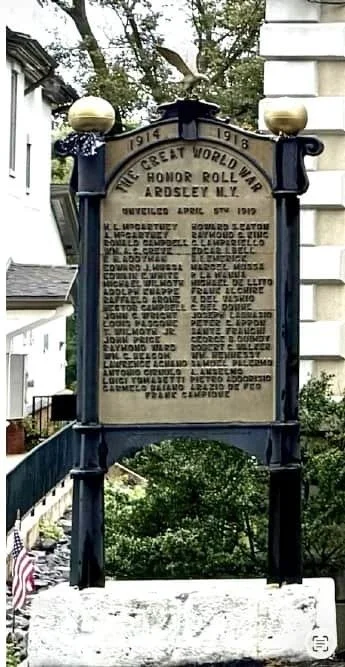
The Great War Honor Roll, unveiled April 5, 1919, which has stood on Ashford Avenue outside Village Hall for more than a century.
The Prohibitionists of Ardsley
Neither cause was new. Organized temperance goes back to the American Temperance Society of 1826. The Prohibition Party followed in 1869 and remains active today, the oldest third party in the country. [2] In September 1885 its members held a convention in Ardsley and nominated John P. King for the State Assembly. [3] King's father, Captain John King, ran the pickle works at the end of what is now King Street and gave the land for the village's Methodist church. [4] The son became Ardsley's first local judge and for years ran the church's Sunday School. [5] His Prohibitionism followed naturally: Methodists were among the saloon's most determined enemies. [6]
The cause found other adherents in the village. On Labor Day 1896 the county's Prohibitionists met at Sing Sing and nominated Dr. George Quincy Johnson (c. 1859–1939) of Ardsley for county coroner. [7] Johnson was a physician who had moved to the village the year before. He later served as its postmaster and health officer and, eventually, as its third Village President. [8]
Women had been asking for the vote since the Seneca Falls Convention of 1848, and the Prohibition Party was one of the first to back them. Part of that was principle. The party came out of the same evangelical reform world as the antislavery movement, and its 1869 platform called for the vote regardless of race or sex. Part of it was arithmetic. Women bore the worst of what the saloon did to a family, and the drys assumed they would vote accordingly. [9] It took a war to carry both causes over the line.
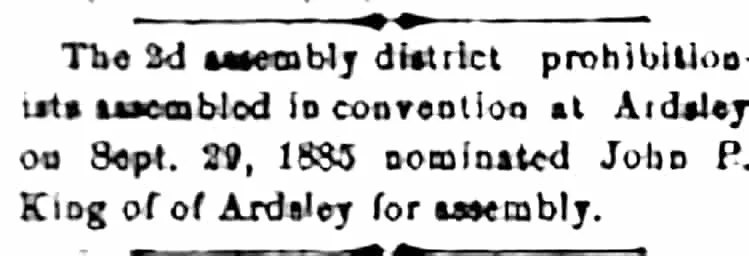
From the October 3, 1885, Eastern State Journal, White Plains.
Over There, and Over Here
Benjamin L. Fairchild, a Pelham Manor Republican whose father had fought in the Civil War, took his seat as Ardsley's congressman in March 1917. Within weeks, on April 6, he voted to declare war on Germany. The resolution passed the House 373 to 50, and the United States entered the war. [10]
The war was paid for largely with Liberty Bonds, and buying them was presented as a patriotic duty. In October 1918, at a bond rally in the auditorium of Ardsley's school, Adolph Lewisohn, the German-born copper magnate and philanthropist whose Westchester home since 1906 had been Heatherdell Farm, a 356-acre estate in Ardsley, promised to match whatever Ardsley raised in the last week of the drive. He did it at a time when being born in Germany was enough to make a man's loyalty suspect. [11]
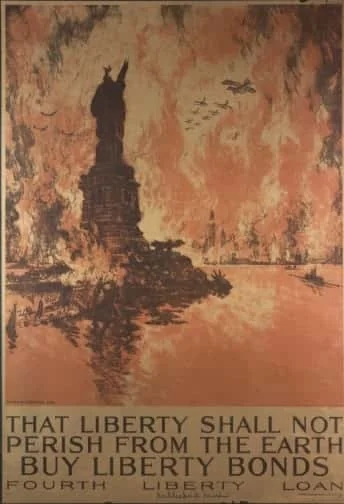
"That Liberty Shall Not Perish from the Earth," Joseph Pennell's poster for the Fourth Liberty Loan, the October 1918 drive Lewisohn promoted in Ardsley. (Library of Congress)
How Long Must Women Wait?
Women ran farms and factories, sold Liberty Bonds and nursed the wounded in France. About 11,000 joined the Navy as Yeomen (F), the "yeomanettes," doing men's jobs for men's pay. [12] Outside the White House, suffragists held up banners asking how the country could fight for democracy in Europe while denying it to half its own citizens. In 1918 Wilson himself told the Senate that suffrage was "vitally essential" to winning the war. [13]
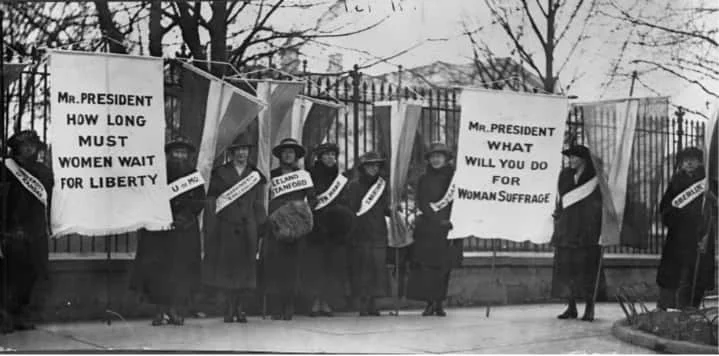
"Mr. President, How Long Must Women Wait for Liberty?" College women picket the White House in 1917, demanding full access to voting rights. (Library of Congress, Prints & Photographs Division, via National Park Service, "Women's Suffrage and WWI")
New York had already moved, and Ardsley had a voice in it. In October 1913, Miss Marie B. Ames, a speaker for the New York State Woman Suffrage Association, lectured on woman suffrage at the moving picture show in the Ardsley Lyceum. The Lyceum was the village's public hall, where talks, debates and civic meetings were held and where Ardsley had celebrated its incorporation in 1896. [14] Back in 1915 Lewisohn told a suffrage meeting in Manhattan that he had "never heard a good argument against woman suffrage." To the old claim that voting would pull women out of the home, he gave a businessman's answer. Suffragists and anti-suffragists alike, he said, "are out of the home a great deal already, working for the vote or against the vote. It would take no more of their time to vote." [15] Two years later New York's voters agreed with him. On November 5, 1918, Ardsley women voted in a general election for the first time. [16] Six days later the war was over.
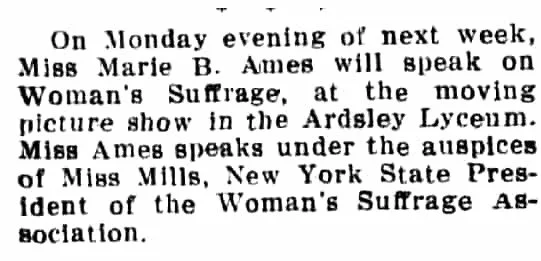
From the October 3, 1913, Dobbs Ferry Register.
Congress passed the 19th Amendment in June 1919, and New York ratified it within two weeks. It is one sentence long: "The right of citizens of the United States to vote shall not be denied or abridged by the United States or by any State on account of sex." [17] Until then a woman's right to vote depended on where she lived. Only about fifteen states, mostly in the West, gave women full voting rights. Ratification finally came down to Tennessee in August 1920, where a 24-year-old legislator named Harry Burn cast the deciding vote after getting a letter from his mother, Febb, telling him to support suffrage. [18] That November women all over the country voted for president.
Ardsley's experience fit a pattern. Historians such as Alexander Keyssar and Jill Lepore have shown how often war has pushed the Constitution to change, and Keyssar puts it bluntly: "every major expansion of the right to vote in American history occurred during or just after a war." [19] It happened again half a century later. During Vietnam, eighteen-year-olds could be drafted but couldn't vote, and "old enough to fight, old enough to vote" became a slogan. The 26th Amendment, lowering the voting age to 18, was ratified in 1971 in about a hundred days, faster than any amendment before or since. [20] Without Vietnam, Keyssar says, the voting age "might still be twenty-one." Thirteen years later the National Minimum Drinking Age Act of 1984 used federal highway money to push every state to a drinking age of 21. As a result, Americans old enough to vote and to fight could no longer legally buy a beer. [21]
Not to Win, but to Swing
Suffrage was won by persuasion and protest. Prohibition was won by pressure politics. By the time of the war, the dry movement's real muscle was no longer the Prohibition Party but the Anti-Saloon League, founded in Ohio in 1893 and often called the first modern single-issue lobby. The Prohibition Party ran in election after election and never came close to winning. The League never ran at all. It didn't need to win elections, only to swing them. Rather than replace officeholders, the League made them fear its voters, backing any candidate, Democrat or Republican, who would vote dry and working to defeat anyone who wouldn't. [22]
The Country Goes Dry (Sort Of)
Prohibition was sold as a war measure too, and the war handed the League its best arguments. Grain belonged in Allied bread, not in beer. Soldiers belonged far from saloons. And German-American brewers were painted as friends of the Kaiser. Washington could also now afford Prohibition. Liquor taxes had long been one of the federal government's largest sources of revenue, but the 16th Amendment, ratified in 1913, created the income tax, arguably making a national ban on liquor practical for the first time. In December 1917, with American troops gathering in France, Congress passed the 18th Amendment. It banned the "manufacture, sale, or transportation of intoxicating liquors," along with their import and export. [23] Curiously, it did not ban possession or consumption. A citizen could keep what lay in the cellar but could no longer lawfully make, buy or sell more.
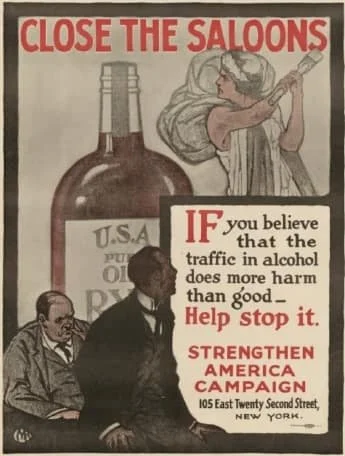
"Close the Saloons," a poster of the Strengthen America Campaign, New York, about 1914–1918. (National Archives)
It was the most sweeping sumptuary law in American history, an attempt to regulate what an entire nation could consume, and its backers were in a hurry. The amendment still had to be ratified, and it gave the country a year's grace after that. Ten days after the armistice Wilson signed a Wartime Prohibition Act, officially to save grain until the troops came home. [24] The states ratified the amendment in January 1919, the wartime ban took effect that July while many soldiers were still overseas, and the country stayed dry under it until the amendment itself took effect in January 1920.
The amendment never said what "intoxicating" meant. That job fell to the Volstead Act, named for Representative Andrew Volstead of Minnesota, chairman of the House Judiciary Committee, though much of it was drafted by the Anti-Saloon League. Passed in October 1919 over Wilson's veto, it drew the line at one-half of one percent alcohol, which outlawed ordinary beer and wine along with hard liquor. [25] Many Americans had expected light beer and wine to survive, and the strict limit came as a shock. The old alliance between the two causes cut the other way too. Expecting women to vote dry, the liquor industry had quietly paid for the fight against suffrage. [26] The Prohibitionists had won.
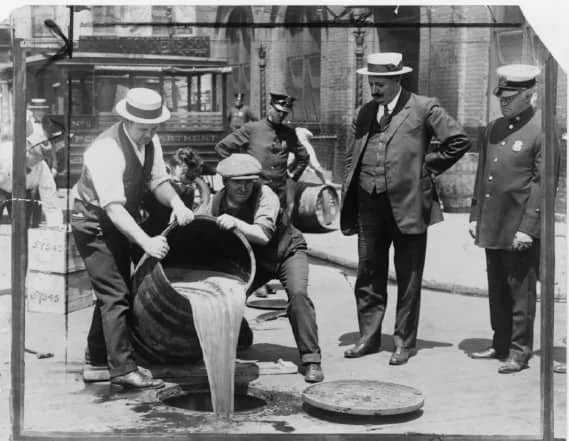
New York Deputy Police Commissioner John A. Leach (right) watches agents pour liquor into a sewer after a raid, about 1921. (Library of Congress)
Victory Calls
The news reached Ardsley on the morning of November 11. "Ardsley celebrated Germany's signing of the armistice in no uncertain manner," the Dobbs Ferry Register reported that week. The church bell, the fire whistle and the school bell woke the village "bright and early." Young women from Nepperhan Street went from house to house "making victory calls," the Italian population "was not slow in starting a procession through the village," and that night Ardsley was "well illuminated and exceedingly noisy." [27]
That school bell has outlasted nearly everyone who heard it that morning. In 1887 the school board paid $40 for it, for the new schoolhouse it was building on Ashford Avenue, on the site of today's Municipal Building. It went on to ring in Ardsley's new High School, begun with a cornerstone in 1912 and opened to students in September 1913. On November 19, 1972, the bell was dedicated in front of the new Middle School, where it sits today in rather forlorn shape. Its clapper is missing, and a recent visual inspection could not determine which foundry cast it.
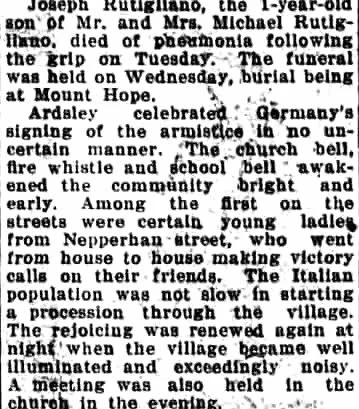
From the November 15, 1918, Dobbs Ferry Register.
In its working years the bell rang for more than the school day. Arthur Silliman, district principal from 1922 to 1958, remembered it ringing at ceremonies that rewarded students for punctuality and perfect attendance. Village boys had their own tradition: tolling it at midnight on Halloween. For that, the boys evidently had to get inside the school. In 1934 more than thirty of them "waited in vain until midnight," the Bronxville Press reported; when they tried to get in, they found a janitor who had been ordered to stay on duty all night. Ardsley's custom was tame by comparison. In Scarsdale that night, youngsters opened ten fire hydrants and set seven small fires, keeping the fire companies busy from dusk to midnight. [28]
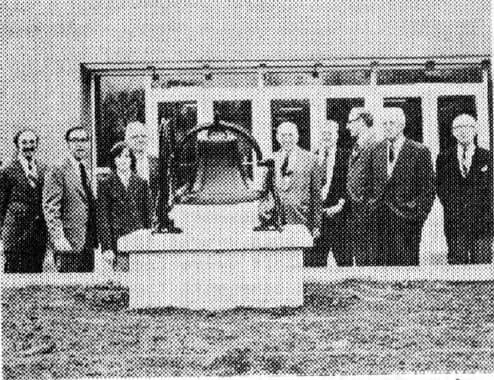
The school bell at its dedication outside the new Middle School, November 19, 1972. Photograph by Bruce Berkman, Ardsley Public Schools Newsletter, December 1972.
Back in 1918, the Register's front page that week carried news that mattered as much to many Ardsley families. "Almost the first action of the War Department Monday," the paper reported, "was the cancellation of all army draft calls," stopping more than 300,000 men who had been ordered to report to camp before November 30. Some 2.7 million men had been inducted since the first calls in August 1917. For the young men who had registered only that September, when the draft was widened to men from 18 to 45, the call would never come.
The Ardsley column carried a quieter item. Joseph Rutigliano, the one-year-old son of Mr. and Mrs. Michael Rutigliano, had died of pneumonia that week, following "the grip," the influenza then sweeping the world. He was buried at Mount Hope. "Grip" was a common spelling of grippe, the French name for the disease, from the word for "seizure," for the way it seized its victims without warning. "Influenza" came from Italian, after the old belief that epidemics were caused by the influence of the stars. [29] The pandemic of 1918 killed an estimated 675,000 Americans, far more than died in combat, and it did not stop for the peace. Not every Ardsley soldier came home, either. Private First Class Francesco Campione and Private Luigi Tomosetti, both of Company C, 311th Infantry, were killed in the Meuse-Argonne offensive on October 20 and October 22, 1918, less than three weeks before the armistice. [30]
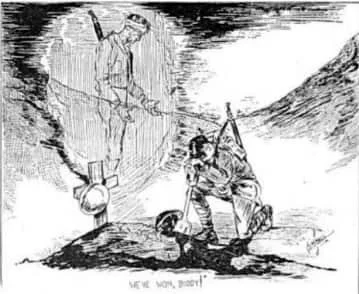
"Four Years Ago Peace," E. Simms Campbell's elegiac editorial cartoon, drawn at 16, won a national high school prize in 1922 and ran in the NAACP's The Crisis in March 1923. Its fallen soldier assures the living, "We've won, Buddy," to a nation still reckoning with the war's human cost, as Wilson's promise of a lasting peace, and the hope that this had been the war to end all wars, were already proving elusive. Campbell, who became the first Black cartoonist widely published in national magazines, later lived in the hamlet of Worthington, just north of Ardsley.
Tomosetti's Army burial card ties him to both Italy and Ardsley. It lists his mother, Mrs. Cecilia Tomasetti, in Flammignano, a hamlet of Tossicia in Italy's Abruzzo region, and gives as his emergency contact a friend in Ardsley. He was first buried in an isolated grave at Chevières in the Ardennes and moved in April 1919 to the Meuse-Argonne American Cemetery at Romagne-sous-Montfaucon, where he lies today. [31]
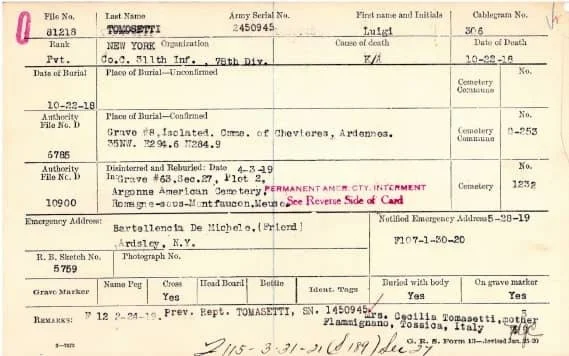
Burial card for Pvt. Luigi Tomosetti, Co. C, 311th Infantry, 78th Division. (American Battle Monuments Commission, Meuse-Argonne American Cemetery)
The names of Ardsley's servicemen went up on the Great War Honor Roll, unveiled on April 5, 1919, two years almost to the day after Fairchild's vote for war. The roll came from an unlikely place: the Lebanon Machine Company of Lebanon, New Hampshire, which made iron, bronze and aluminum tablets and highway signs. Its advertisements, headlined "When the Boys Come Home," urged towns to replace their wooden honor boards before returning soldiers found "the more or less dilapidated remains of that old wooden sign." "Will the boys return all at once?" the ad asked. "Some never." [32]
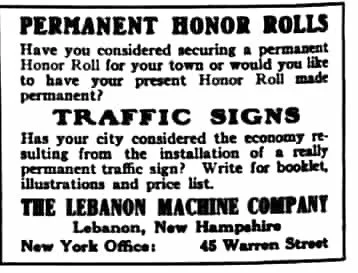
From The American City, vol. 21, 1919, p. 94. The company kept a New York office at 45 Warren Street.
In 1921 Ardsley's veterans founded American Legion Post #458. [33] They had gone to fight for democracy and came home to find their sisters could vote and their saloons were closed.
Twenty years after the armistice, the Great War was still fresh in Ardsley's memory. On a snowy February morning in 1939, twelve Ardsley commuters, fed up with the fumes of the Putnam Division's gasoline-powered trains, gathered early at "Doc" Engleman's drugstore near the station to receive gas masks from members of the American Legion, all of them veterans of the Great War, then marched under police escort to the 8:31 train. Their placard asked: "Why go to France and be gassed? It does happen here-on the Putnam Division." They were a cross-section of the morning commute: Mrs. Lorraine Ruprecht, an art director and the first woman to put on a mask; Blaise Recca, a production manager at a publishing firm, who made the placard; a Greenburgh councilman, a Wall Street broker, an electrical engineer and others from insurance and publishing. Two college students from Briarcliff Manor joined them on the platform. Once aboard, the masked commuters tried to go about their usual routine: they played bridge and read the newspapers. The stunt was a media sensation, covered by The New York Times and photographed for the national wire services. [34]
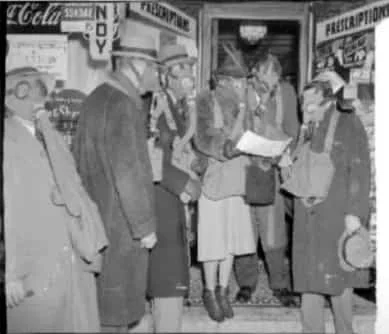
Ardsley commuters in borrowed gas masks check a train schedule outside "Doc" Engleman's drugstore near the station, February 7, 1939. (Wire service photograph)
The Feds Order a Round
Through the Prohibition years, Ardsley, it seems, remained bibulous. In August 1931, under an Ardsley dateline, the Daily Argus reported that federal agents had raided the Westchester Casino on the Saw Mill River Road. They bought liquor first, then arrested four men and dumped five barrels of beer. [35]
Raids like this one occurred across the country and deterred few. Bootleggers prospered, and police and politicians were bought.
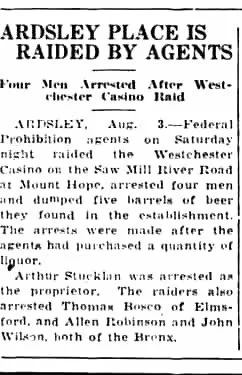
From the August 3, 1931, Daily Argus, Mount Vernon.
Last Call: Ardsley Votes Wet, Eight to One
In May 1933 Ardsley voted 327 to 44 for repeal, "8 to 1," as The Hastings News put it. [36] Forty-eight years after John P. King's Prohibitionists had met in the village, their cause lost here in a landslide. Franklin Roosevelt had run on repeal the year before and won a landslide of his own. Women, who the liquor industry had once feared would vote dry, helped bring Prohibition down: by 1932 the Women's Organization for National Prohibition Reform was urging mothers to vote repeal for their children's sake. That December the 21st Amendment repealed the 18th, the only time an amendment has ever been undone. A cause that took nearly a century to win lasted barely fourteen years. It had asked millions of people to give up something they never stopped wanting, and the Depression tipped the balance. The income tax that had made Prohibition affordable shrank along with Americans' incomes, and legal liquor suddenly looked like jobs for the unemployed and tax revenue for an empty Treasury. The country decided the experiment had failed.
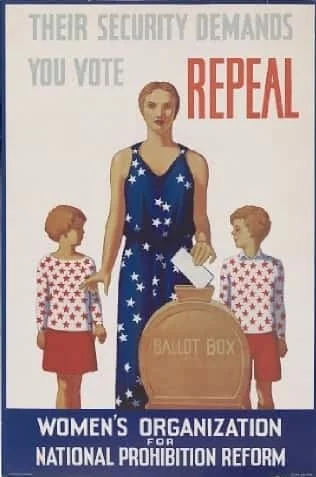
"Their Security Demands You Vote Repeal," Women's Organization for National Prohibition Reform, 1932. (Princeton University Posters Collection, Archives Center, National Museum of American History)
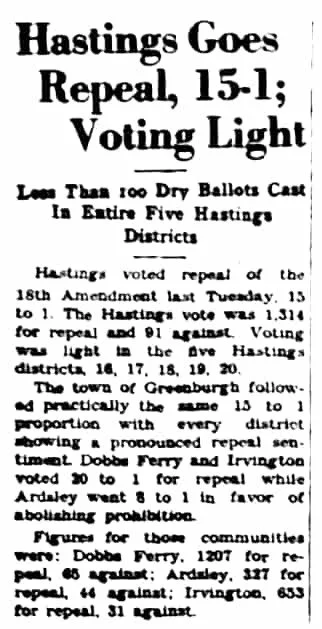
From the May 26, 1933, Hastings News.
Fairchild's Two-Term Amendment
Benjamin Fairchild lost his seat in the election of November 1918 but returned to Congress in 1921, and while Prohibition was still the law he proposed an amendment limiting presidents to two terms. With Washington's two-term custom still unbroken, it must have seemed otiose, a fix for a problem nobody had. It went nowhere.
It took another war to bring it back. Franklin Roosevelt ran for an unprecedented third term in 1940, as war spread across Europe. Critics called him a potential dictator; others warned that a third term would lead to war. [37] Strikingly, his own vice president, John Nance Garner, broke with him over the third term and sought the nomination himself.
The United States was not at war, but it was rearming, and Congress was debating the first peacetime draft in the nation's history. Nominated that July at the party's convention in Chicago, which he did not attend, Roosevelt accepted by radio from the White House. He said he had lain awake asking whether he had the right, as commander in chief, "to call on men and women to serve their country" while declining to serve himself. An "overriding public danger," he said, had repealed all private plans, his retirement among them. [38] He won that November, and took a fourth term in 1944, with American troops fighting overseas. Voters retained him through the emergency, but many were uneasy about the precedent. Roosevelt died in April 1945, not three months into his fourth term, and in 1946 the Republicans, who had been calling for a two-term limit since 1940, won back control of both houses of Congress for the first time since the early 1930s. [39]
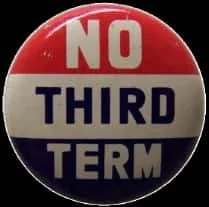
"No Third Term," a 1940 anti-Roosevelt campaign button. (Franklin D. Roosevelt Presidential Library and Museum)
Fairchild did not live to see the outcome. He died in October 1946. On January 8, 1947, Rep. Ralph Gamble rose in the House to announce his death and called him "far ahead of his time, a progressive and far-sighted legislator." [40] Within weeks the House proved just how far ahead. On February 6, 1947, it passed a two-term amendment much like the one Fairchild had proposed some twenty years earlier. It was ratified in 1951 as the 22nd Amendment. [41]
Hamilton Versus Jefferson
The argument was as old as the Republic. In Federalist No. 72, Alexander Hamilton warned that limiting reelection would mean "banishing men from stations" where, "in certain emergencies of the state," their presence might matter most. Jefferson, who turned down a third term, saw it the other way. Without a limit, he wrote, a president's office "will in fact, become for life." [42] Congress sided with Jefferson. Jill Lepore sees that as the system working as intended. She describes the amendment process as a "mechanism for the prevention of insurrection." [43] Americans settled a hard question by amendment rather than by force, and they remain free to reopen it, and even reverse it, by the same means.
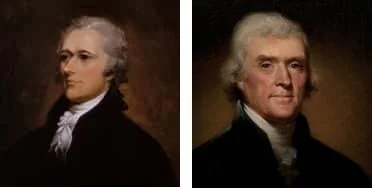
Alexander Hamilton (John Trumbull, c. 1805, after a bust by Giuseppe Ceracchi) and Thomas Jefferson (Rembrandt Peale, 1800). (White House Collection)
A Country That Can Change Its Mind
By my count, at least seven of the Constitution's 27 amendments came out of America's wars: three after the Civil War, two after World War I, the 22nd after World War II and the 26th during Vietnam. Others have looser ties, from the Bill of Rights, written in the shadow of the Revolution, to the 25th, which set rules for a disabled president in the nuclear age after President Kennedy was killed.
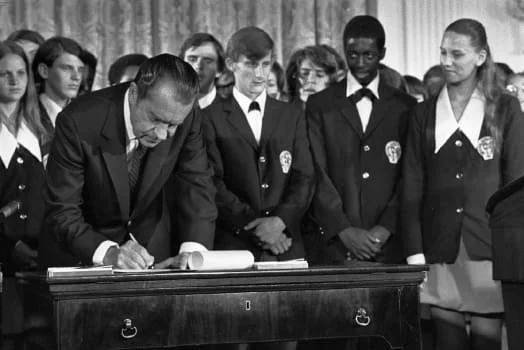
President Nixon signs the certified 26th Amendment, lowering the voting age to 18, as three 18-year-old witnesses from Young Americans in Concert look on, East Room of the White House, July 5, 1971. (White House Photo Office, WHPO-6749-09A, Richard Nixon Presidential Library and Museum)
Most proposed amendments, like Fairchild's, fail the first time. The Equal Rights Amendment, first introduced in 1923, three years after the 19th, passed Congress in 1972 but fell short. Its central guarantee, like the 19th's, is a single sentence: "Equality of rights under the law shall not be denied or abridged by the United States or by any State on account of sex." Some amendments succeed decades later. A few, like Prohibition, pass and are later repealed. Ardsley lived through every stage of it: a Prohibition convention in 1885, a vote for war in 1917, women at the polls in 1918, a raid in 1931, repeal in 1933 and an idea that had to wait twenty years. The amendment that let more people into the democracy lasted. The one that told people how to live did not.
The veterans of Post #458 saw most of it. What they fought for, in the end, was a country that can change its mind.
Never Forgotten
Ardsley has looked after their memory, and the memory of those who came after them. On November 11, 1954, the first holiday ever celebrated as Veterans Day, the Ardsley school district dedicated a memorial to fourteen former Ardsley students who died in World War II. It stood in front of the first Ardsley High School, across the street from the Great War Honor Roll. In time it disappeared. The Ardsley Historical Society located and restored it, and on Memorial Day of this year it was rededicated as the centerpiece of the Lewisohn Memorial Garden at Ardsley High School on Farm Road, on land that was once part of Lewisohn's Heatherdell Farm. [44]
A quarter century after the armistice, Ardsley's young men were back in France, and five of the fourteen still lie in American military cemeteries in Europe. One is First Lieutenant Frederick C. Baker of the 38th Infantry, 2nd Division, killed on August 25, 1944, probably in the attack on Brest. His parents had moved from Ardsley to Chicago, which is why his headstone reads "Illinois." "Those who knew Fred," an Ardsley wartime bulletin wrote, "can picture him in the forefront of the attack, encouraging his men, with no thought of personal safety, only of duty." He is buried at the Brittany American Cemetery in St. James, in Normandy.
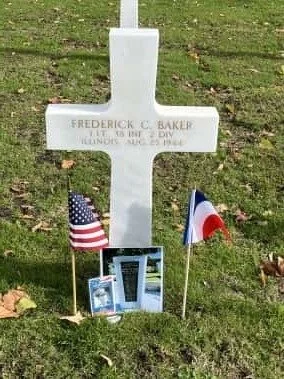
The grave of 1st Lt. Frederick C. Baker at the Brittany American Cemetery, St. James, Normandy, France, October 21, 2026, with his Ardsley Honors banner flag and a photograph of the restored World War II memorial. Photograph by Sharon Engleman Colabello.
In 2023 his name joined the Military Tribute Banners that hang along Ashford Avenue each November. The program was initiated by Sharon Engleman Colabello, Ardsley High School Class of 1974, with American Legion Post #458, under Commander Efrain Hernandez, helping to promote it and enroll participants. Her father, Marty Engleman, Ardsley High School Class of 1944, was the son of "Doc" Engleman, at whose drugstore the gas-mask commuters had gathered in 1939. Marty was a decorated World War II veteran who later ran Marty's Mug & Munch, twice voted best hamburger in Westchester. On October 21 of this year Colabello visited Baker's grave, left his banner flag and a photograph of the restored memorial at the foot of the cross, and wrote two words in the cemetery's guest book: "Never Forgotten." [45]
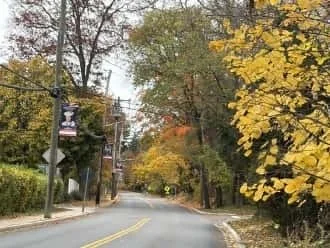
Military Tribute Banners along Heatherdell Road, November 2026.
The Post's first home survived too. James McCartney Jr. helped found the Post, and his father let the veterans meet in the family's real estate office. Around 1923 the family put up a small office building, and in 1928 they gave it to the Legion. When the Post moved to bigger quarters in the 1950s, the old building was nearly torn down and instead spent decades as a one-car garage on Northfield Avenue in Dobbs Ferry.
In 2010 Paul Petretti, Ardsley High School Class of 1968, a Vietnam veteran, civil engineer and land surveyor, and a member of Post #458, heard the building's story from his mother. Ninety years after Febb Burn's letter helped win women the vote, another mother's words started a rescue. Petretti set out to bring the building home. It became a community project. Ralph and Christopher Denike moved it, local contractors gave it a new foundation, stucco, windows and wiring, and Eagle Scout Brian Bounos and his family restored the interior. A scroll inside the building thanks everyone who contributed. It now stands in Pascone Park beside the World War II Roll of Honor, which lists those from Ardsley who served, with a star beside each of the fourteen who died. [46]
Ardsley's Department of Public Works recently repainted it and hung new copper gutters and leaders. It is open to the public every Veterans Day. This year, readers may wish to visit all three: the Great War Honor Roll, the Legion building and the World War II memorial in the Lewisohn Memorial Garden.
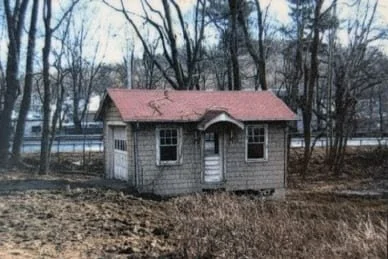
The Post's first home in its garage years on Northfield Avenue, Dobbs Ferry, before its return to Ardsley. (From the Ardsley Historical Society display at Pascone Park)
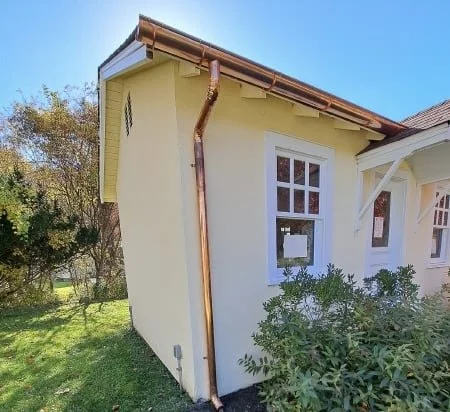
The Post's first home, freshly painted and fitted with new copper gutters and leaders by Ardsley's Department of Public Works, November 2026.
Endnotes
[1] Armistice Day was proclaimed by President Wilson on November 11, 1919, made a legal holiday by Act of Congress on May 13, 1938, and renamed Veterans Day by an act signed June 1, 1954. U.S. Department of Veterans Affairs, "History of Veterans Day," archived January 26, 2017.
[2] Prohibition Party, "Platform," adopted 2023, amended 2025.
[3] Eastern State Journal (White Plains, NY), October 3, 1885.
[4] "Looking for America: Kings of the Road from Ardsley to Michigan," The Timepiece (Ardsley Historical Society), August 15, 2022. On the gift of land for the Methodist church, information from Ralph D. King.
[5] Ardsley Historical Society Newsletter 26, no. 2 (Spring/Summer 2011).
[6] "An Ancient Bugle with a Modern Sound," in Methodist History, ed. Frederick E. Maser, 123–24 (General Commission on Archives and History, The United Methodist Church). In 1912 the Methodist Episcopal Church established a Board of Temperance, which "worked closely with the Anti-Saloon League in a successful campaign to secure National Prohibition."
[7] "The Prohibitionists held a nominating convention at Sing Sing on Labor day...," Highland Democrat (Peekskill, NY), September 19, 1896, p. 2.
[8] "Dr. George Quincy Johnson," obituary, New York Times, January 26, 1939, p. 27. Born in Hillsdale, N.Y., about 1859, Johnson graduated from the College of Physicians and Surgeons of Columbia University, practiced in Hillsdale and Pine Plains, and moved to Ardsley in 1895. He later served as president of the board of trustees of the Ardsley church (probably the Methodist church, the village's church most closely tied to temperance), president of the medical staff of Dobbs Ferry Hospital and medical officer of the Ardsley schools. He died at Dobbs Ferry Hospital on January 23, 1939, at 79. On his service as Ardsley's third Village President, see Village of Ardsley & Volunteer Fire Dept. 75th Anniversary, 1896–1971: Diamond Jubilee Celebration (Ardsley, NY, October 9, 1971), p. 10, Ardsley History Archives.
[9] "Seneca Falls Resolutions" (1848), Teaching American History; on the Prohibition Party's 1869 platform and its place as "one of the first parties to make women's suffrage a key platform point," see "Prohibition Party," Encyclopedia.com. On the moral and strategic ties between temperance and suffrage, see Ruth Bordin, Woman and Temperance: The Quest for Power and Liberty, 1873–1900 (Philadelphia: Temple University Press, 1981).
[10] U.S. House of Representatives, History, Art & Archives, "Declaration of War Against Germany"; roll call in Congressional Record 55 (April 5–6, 1917).
[11] "Amici Usque Ad Aras: From Ancient Athens to Ardsley – Sic Transit Gloria Mundi," The Timepiece (Ardsley Historical Society), April 6, 2026, citing the Irvington Gazette, October 19, 1918. See also Henning Albrecht, Adolph Lewisohn: Copper Magnate in the "Gilded Age" (Hamburg: Hamburg University Press, 2019); on the estate, see Ardsley Historical Society, "Lewisohn Memorial Garden."
[12] The Naval Reserve Act of 1916 referred to "persons" rather than "men," and Navy Secretary Josephus Daniels used that wording to enlist women. The Navy announced on March 19, 1917, that it would accept women. Yeomen (F) served mainly as clerks, telephone operators, translators and draftsmen at stateside naval stations, freeing men for sea duty. They wore uniforms, held rank, received the same pay as men of the same grade, and were later recognized as veterans. All were released from service by 1919. Naval History and Heritage Command, "A Historical Overview of the Yeomen (F)."
[13] Woodrow Wilson, "Address to the Senate on the Nineteenth Amendment," September 30, 1918, American Presidency Project; see also U.S. Senate, "A Vote for Women."
[14] Dobbs Ferry Register, October 3, 1913. On the Ardsley Lyceum and the incorporation banquet of March 5, 1896, see Ardsley Historical Society, "Ardsley History Timeline."
[15] "Shows Suffrage as Aid to Nation: Adolph Lewisohn Says Average Man Knows but Little About Politics," New York Tribune, April 1, 1915.
[16] New York voters approved women's suffrage in a statewide referendum in November 1917. The general election of November 5, 1918, was the first in which New York women voted. "106 Years Ago, New York Women Voted for the First Time," 6sqft, November 5, 2024.
[17] U.S. Constitution, Amendment XIX. Passed by Congress June 4, 1919; ratified by New York June 16, 1919; certified August 26, 1920. See National Park Service, "New York and the 19th Amendment."
[18] Rep. Harry T. Burn of McMinn County, Tennessee, voted for ratification on August 18, 1920, after receiving a letter from his mother, Phoebe "Febb" Ensminger Burn, urging him to "be a good boy" and vote for suffrage. National Park Service, "Harry T. Burn"; National Constitution Center, "The Man and His Mom Who Gave Women the Vote."
[19] Alexander Keyssar, interview by Donald A. Yerxa, "The Right to Vote," Books & Culture, November 15, 2000; see also Alexander Keyssar, The Right to Vote: The Contested History of Democracy in the United States (New York: Basic Books, 2000; rev. ed. 2009).
[20] The 26th Amendment was sent to the states on March 23, 1971, and ratified on July 1, 1971.
[21] Keyssar, interview by Yerxa. National Minimum Drinking Age Act of 1984, Pub. L. 98-363, codified at 23 U.S.C. § 158, which withheld a share of federal highway funds from states that allowed anyone under 21 to buy alcohol.
[22] Peter H. Odegard, Pressure Politics: The Story of the Anti-Saloon League (New York: Columbia University Press, 1928), the classic study of the League's methods; K. Austin Kerr, Organized for Prohibition: A New History of the Anti- Saloon League (New Haven: Yale University Press, 1985); and Daniel Okrent, Last Call: The Rise and Fall of Prohibition (New York: Scribner, 2010).
[23] U.S. Constitution, Amendment XVIII, Section 1. Passed by Congress December 18, 1917; ratified January 16, 1919; effective January 17, 1920.
[24] Wartime Prohibition Act, signed November 21, 1918, effective June 30, 1919; upheld in Hamilton v. Kentucky Distilleries & Warehouse Co., 251 U.S. 146 (1919).
[25] National Prohibition Act (Volstead Act), enacted October 28, 1919, over President Wilson's veto. See U.S. Senate, "The Volstead Act."
[26] Okrent, Last Call.
[27] "Ardsley" and "All Draft Calls Cancelled," Dobbs Ferry Register, November 15, 1918. On the influenza pandemic, see Centers for Disease Control and Prevention, "1918 Pandemic (H1N1 virus)."
[28] Arthur W. Silliman, A Short Informal History of Ardsley, N.Y., vol. 3 (n.p.: Welt-Verlag, 1976), which records the board's 1887 purchase and reproduces "Ardsley Bell Dedicated," Ardsley Public Schools Newsletter, December 1972. Ardsley Village Historian Robert Pellegrino confirms the 1887 date (an announcement of the 1972 dedication gives 1884 in error) and notes that the High School's cornerstone was laid in 1912 and its first academic year began in September 1913. On the Halloween tradition, see "Hallowe'en Celebrated in Different Ways," Bronxville Press, November 2, 1934.
[29] Merriam-Webster, "'Tis the (Flu) Season: The History of 'Influenza'," Wordplay.
[30] In Memoriam plaque, Great War memorial, Ashford Avenue, Ardsley. See also "America's Divided Loyalties," The Timepiece (Ardsley Historical Society), July 4, 2023. The 311th Infantry belonged to the 78th "Lightning" Division, whose men wore "the forked lightning upon their left shoulder." Thomas F. Meehan, ed., History of the Seventy-eighth Division in the World War, 1917-18-19 (New York: Dodd, Mead, 1921), 14.
[31] Graves Registration Service burial card (G.R.S. Form 13) for Pvt. Luigi Tomosetti, Army serial no. 2450945, Co. C, 311th Infantry, 78th Division, killed in action October 22, 1918. The card notes he was "previously reported" as Tomasetti. Courtesy of the American Battle Monuments Commission, Meuse-Argonne American Cemetery, Rue du Général Pershing, 55110 Romagne-sous-Montfaucon, France.
[32] Lebanon Machine Company, "When the Boys Come Home," advertisement, American City 20 (January–June 1919): 62. The Ardsley honor roll bears the Lebanon Machine Company's maker's mark and the inscription "Unveiled April 5th 1919." See "Ardsley World War I Honor Roll," Historical Marker Database. The title of this Timepiece is borrowed, with gratitude, from the company's advertisement.
[33] Ardsley Historical Society, "Roll of Honor / Ardsley American Legion Museum."
[34] Punxsutawney Spirit (Punxsutawney, PA), February 8, 1939, 8, a wire report of the protest; see also "Gas Mask Brigade to Invade Trains," New York Times, February 6, 1939; and "The Gas-Masked Train Invasion in Ardsley," February 4, 2016.
[35] "Ardsley Place Is Raided by Agents," Daily Argus (Mount Vernon, NY), August 3, 1931.
[36] "Hastings Goes Repeal, 15-1; Voting Light," Hastings News (Hastings-on-Hudson, NY), May 26, 1933.
[37] Franklin D. Roosevelt Presidential Library and Museum, "Anti-Roosevelt Campaign Button, 1940," National Archives Identifier 735948.
[38] Franklin D. Roosevelt, "Radio Address to the Democratic National Convention Accepting the Nomination," July 19, 1940, American Presidency Project. See also Richard Moe, Roosevelt's Second Act: The Election of 1940 and the Politics of War (New York: Oxford University Press, 2013); and Susan Dunn, 1940: FDR, Willkie, Lindbergh, Hitler: The Election amid the Storm (New Haven: Yale University Press, 2013).
[39] Republican Party Platform of 1940, June 24, 1940, "Third Term": "we favor an amendment to the Constitution providing that no person shall be President of the United States for more than two terms." American Presidency Project.
[40] Remarks of Rep. Ralph A. Gamble, "The Late Honorable Benjamin Irving Taylor and the Late Honorable Benjamin Lewis Fairchild," Congressional Record 93 (January 8, 1947): 181, via Google Books.
[41] U.S. Capitol Visitor Center, "H.J. Res. 27, Joint Resolution Proposing an Amendment to the Constitution Relating to the Terms of Office of the President." Ratified February 27, 1951.
[42] Alexander Hamilton, Federalist No. 72 (1788); Thomas Jefferson to the Legislature of Vermont, December 10, 1807, Teaching American History.
[43] Jill Lepore, We the People: A History of the U.S. Constitution (New York: Liveright, 2025), quoted in Bradley C.S. Watson, "Amend It, Don't End It," Claremont Review of Books, Winter 2025/26.
[44] "Ardsley Community Honors Fallen WWII Students on Memorial Day with Restored Memorial Plaque," News 12 Westchester, May 25, 2026, video; Ardsley Historical Society, "Lewisohn Memorial Garden"; Rita Walton, "Garden Restores Legacy of 14 WWII Vets," Rivertowns Dispatch, May 29, 2026.
[45] Ardsley Historical Society, "Lewisohn Memorial Garden" (table of Ardsley's fourteen fallen, giving Baker's date of death, unit and burial at the Brittany American Cemetery); Baker's grave marker; Michael Woyton, "Ardsley Comes Together to Honor 12 Who Died in War," Patch, May 19, 2023; Lanning Taliaferro, "59 Military Tribute Banners Presented to Ardsley Officials," Patch, August 30, 2022. On the fourteen men, see also Fred N. Arone and Patricia Arone, Ardsley, NY: The War Years, 1941–1945 (1995). The 2nd Infantry Division took part in the siege of Brest, in Brittany, in August and September 1944. On Marty Engleman and Marty's Mug & Munch (1969–1989), see Town of Greenburgh, "The Ghost of Restaurants Past in Greenburgh, Part I."
[46] Riley Wentzler and Felicia Barber, "Local Historians and Historic Structures of Greenburgh, Part II" (Town of Greenburgh); see also Ardsley Historical Society Newsletter 22, no. 3 (Fall 2007). Biographical information on Paul Petretti courtesy of Ardsley Village Historian Robert Pellegrino.